

 EN

how-acoustic-waves-penetrate-tissue-during-shockwave-therapy, how-acoustic-waves-penetrate-tissue-during-shockwave-therapy, /blog
EN
A shockwave therapy machine produces acoustic pulses that travel through a treatment head and into the body. How far those waves travel, and how their energy changes along the way, depends on the wave pattern, the tissues it meets, and how the clinician positions the applicator. Understanding this pathway helps explain why treatment settings and technique matter.
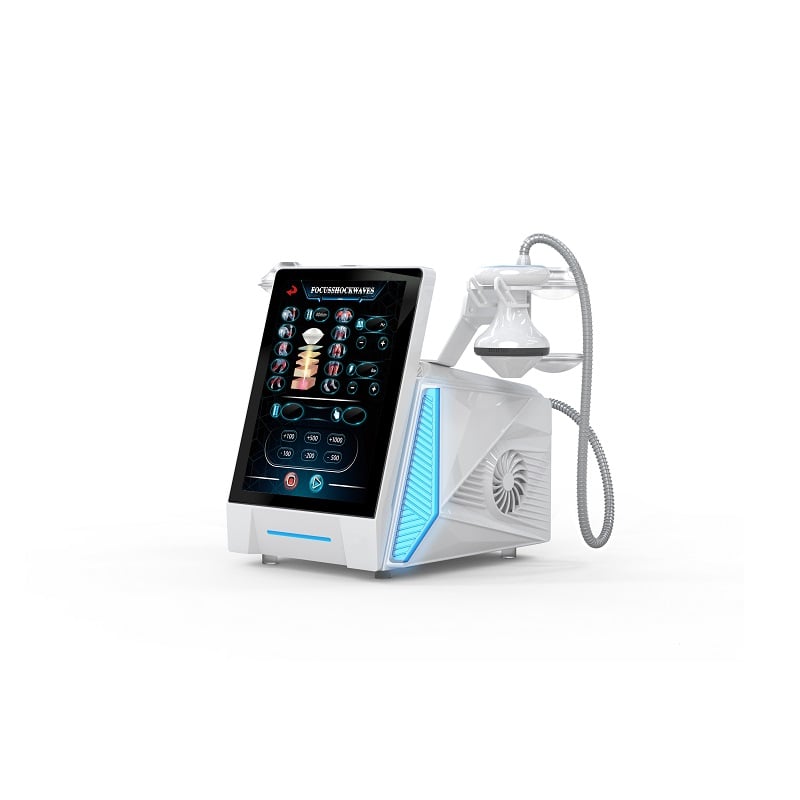
In extracorporeal shockwave therapy, energy is generated outside the body and transferred through an applicator at the skin. The acoustic pulse then encounters layers with different properties, such as skin, fat, muscle, tendon, or bone. This article follows that journey from the treatment head to the target area, with practical context for musculoskeletal therapy and device selection.
A shockwave therapy machine creates a brief pressure disturbance using a mechanism such as a pneumatic source or a focused energy system. The device delivers that disturbance through an applicator, where a coupling medium helps reduce the air gap between the treatment head and the skin. Good contact matters because trapped air reflects much of the acoustic energy instead of allowing it to enter tissue.
In extracorporeal shockwave therapy, the pulse has a rapid rise in pressure followed by a changing pressure profile. A focused system concentrates energy toward a selected depth, while a radial shockwave device typically produces its strongest pressure near the applicator and spreads energy outward. These are distinct delivery patterns, not interchangeable descriptions of a single wave path.
Once the applicator is coupled to the skin, the acoustic wave crosses the skin and proceeds into underlying structures. At each boundary, some energy continues forward, some is reflected, and some is absorbed. The amount depends in part on acoustic impedance, a property related to a tissue’s density and the speed of sound through it.
A radial shockwave device therefore depends on stable contact and suitable positioning, while focused delivery also depends on aiming the energy toward the intended region. The clinician may use gel or another appropriate coupling medium and adjust the applicator angle to maintain contact. In practical extracorporeal shockwave therapy, these simple setup details help make energy transfer more consistent, though they cannot eliminate normal variation between patients.
After entering the body, a wave does not move through every structure in the same way. Changes in tissue density and elasticity alter its path and energy. Muscle, tendon, and bone each present different acoustic conditions, so the signal may weaken, reflect, or change direction as it passes from one layer to another.
A shockwave therapy machine does not send an identical dose to every point along the path. Energy is gradually redistributed through reflection, absorption, and scattering, and the result depends on the wave type and anatomy. In musculoskeletal therapy, the target may lie beneath several tissue layers, so the treatment plan must account for location rather than relying on a surface setting alone.
With a radial shockwave device, energy generally disperses from the applicator rather than converging at one deep focal point. Focused delivery is designed to concentrate energy at a chosen depth, but the actual distribution still depends on tissue interfaces and positioning. This distinction helps clinicians match extracorporeal shockwave therapy to the clinical question without assuming that one mode is suitable for every structure.
Pressure, pulse frequency, and the number of pulses shape the exposure delivered during a session. Raising a setting does not simply make a wave travel farther; it changes the energy conditions and may affect comfort. A shockwave therapy machine should therefore be adjusted in relation to the treatment goal, patient response, and the area being treated, following the device instructions and clinical judgment.
The acoustic pulse can create mechanical stimulation in tissue, which may influence local biological responses. The precise response depends on the tissue, treatment parameters, and individual circumstances; it should not be described as a guaranteed repair process. For musculoskeletal therapy, clinicians consider symptoms, examination findings, and treatment tolerance together rather than interpreting wave penetration as a stand-alone outcome.
A useful treatment decision starts with the location and nature of the target, not with a preferred machine setting. A clinician considers whether a superficial region or a deeper focal area is being addressed, then selects an appropriate applicator and delivery approach. A radial shockwave device may suit some broad or more superficial treatment areas, while focused delivery may be considered when a defined depth is relevant.
For musculoskeletal therapy, the clinician also considers nearby sensitive structures, the patient’s symptoms, and the purpose of the session. Extracorporeal shockwave therapy is not a substitute for diagnosis, and wave transmission alone cannot establish whether a treatment is suitable. Clear assessment helps set realistic expectations and informs whether treatment should be modified, paused, or combined with other care.
During treatment, the applicator should remain in stable contact, and its location should correspond to the planned target. Patient feedback can help the clinician judge comfort and make measured adjustments, but discomfort is not a precise indicator of energy at depth. A shockwave therapy machine’s displayed parameters describe its output settings; they do not map every tissue response inside the body.
In musculoskeletal therapy, consistent documentation of the treated area, applicator, settings, and response makes follow-up more useful. The clinician can review whether the plan remains appropriate instead of increasing intensity automatically. A radial shockwave device and focused system each have practical limits, including anatomy and tissue variation, so skilled application and individual assessment remain essential to responsible extracorporeal shockwave therapy.
Yes. Waves can cross multiple layers, but reflection, absorption, and scattering alter the energy as they travel. In extracorporeal shockwave therapy, the target’s depth and the intervening anatomy influence the delivery plan.
The delivery patterns differ. A radial shockwave device generally disperses energy outward from the applicator, while focused systems concentrate energy toward a selected region. Which approach fits depends on the clinical target and assessment.
Pressure, frequency, pulse count, and applicator choice all contribute to the treatment exposure. In musculoskeletal therapy, the clinician selects and adjusts settings according to the target, patient response, and device guidance rather than relying on one setting for every case.

